
How Can I Track My Lost Dog Using Scannable Tracking Collars
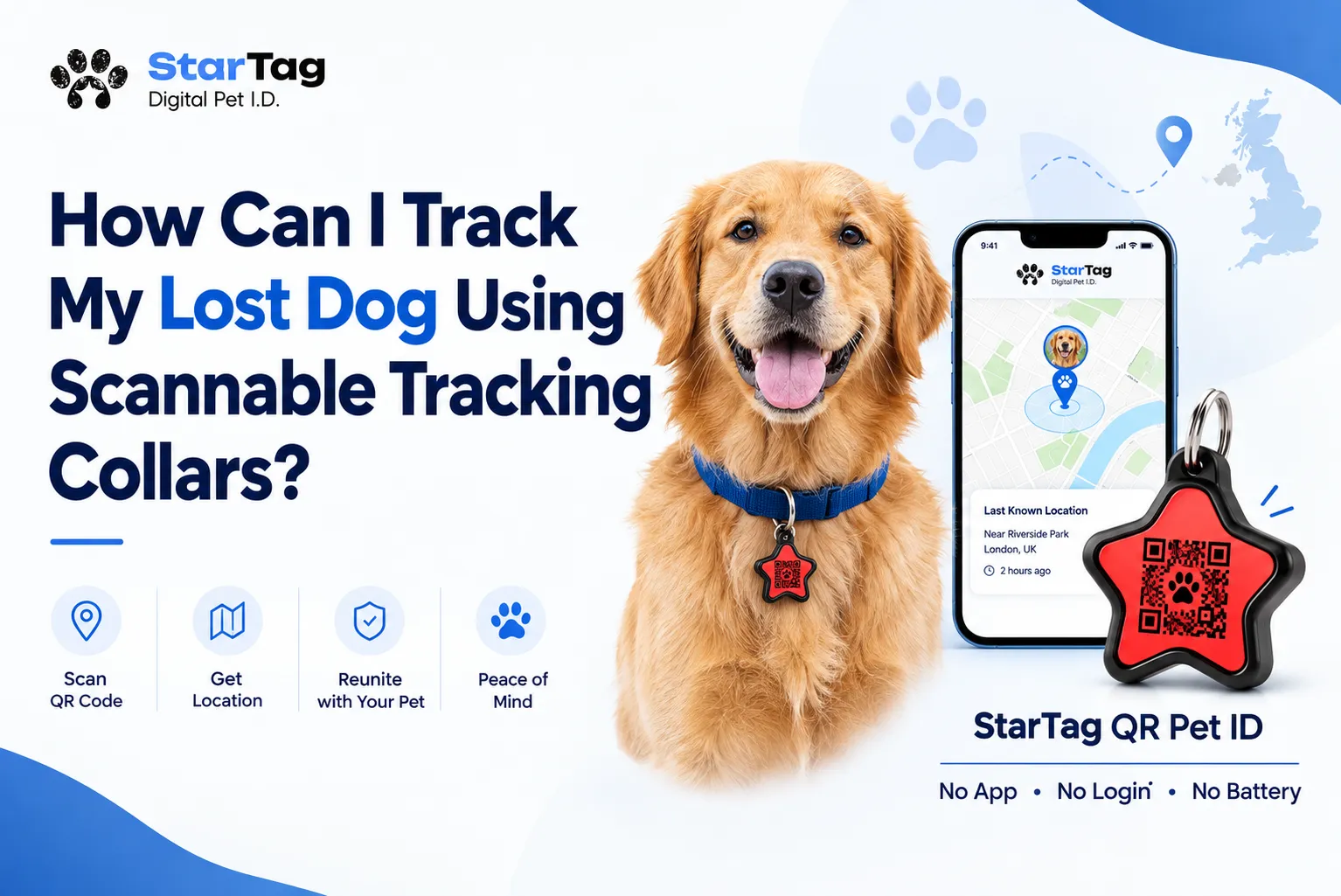
Imagine the scene in the opposite direction for a moment. A person spots your dog walking just a couple of streets away. They're nice enough to let them stop, and then what? You're left with the dog in a state of anxiety and without an obvious way of getting to them, unless the collar makes this subsequent step easy. This is precisely the moment a scannable QR tracking collar is designed for, and that's why numerous pet owners asking "how can I track my lost dog" end up settling on QR-based IDs as their solution instead of engraving a tag or hoping to find someone who recognizes their pet from a poster. A scanner-based collar is different from GPS trackers. It is important to understand that this distinction is crucial, since they solve distinct problems. This is about how to find a missing dog through the fastest possible path back to you: putting your contact information one phone-camera scan away from anyone who finds them. Why a Scannable Collar Solves a Problem Engraved Tags Don't An engraved traditional tag places the number of your mobile directly on a metallic disc that hangs on the collar. This is effective, but it has real drawbacks that the majority of owners do not consider until they're dependent on it during a crisis. The engraving wears away and eventually becomes inaccessible over time, especially for tags with lower cost that are exposed to the elements and continuous movement. The phone number itself provides no information to a locator. It's a call from a stranger, and they have no clue as to whether or not you'll call, if it's in use, or what you can tell them beyond "I think I found your dog." Your private number is displayed in your pet's collar all the time, which is accessible to all and not only to those looking to assist. The scanner-enabled collar is a replacement for static data with a QR code that is linked to a live account. Instead of having a telephone number that could be out of date or inactive, the locating device is given a precise, well-guided method of contacting you instantly using your dog's details and your preferred method of contact, as well as a corresponding messaging method that is secure for the privacy of you and your dog. This is because the entire device only functions if a person who is not familiar with technological setup is able to access it quickly when under pressure and with no hesitation. The phone's camera is built in; there is no installation required on the majority of contemporary QR-enabled tags. Then, they point the tag, and a hyperlink is automatically displayed. The link you click will take you to your dog's page, showing your dog's name and photo and an option to contact you directly. You are immediately notified, usually via push notification as well as SMS and an email, depending on the platform, as well as a response via the same method to schedule a pick-up. The app is not required; there's no logging in, and no confusion as to what you should do. This is precisely why this method is superior to a simple label in terms of closing the loop between "someone found my dog" and "my dog is home." It's essential to be clear on what a collar that scans and one that tracks by satellite each actually do, because confusing the two leads to unbalanced expectations and, in a real emergency, wasted time. A GPS or Bluetooth tracker lets you know exactly where your pet is and can be useful in locating them when your dog is wandering around, particularly when they've wandered off into a place without anyone to locate them. On paper, that sounds like the more advanced solution. In practice, GPS trackers come with limitations that rarely make it into the marketing copy but matter enormously the moment your dog actually goes missing. The battery is working against you at the worst possible time. GPS units draw continuous power to keep a satellite connection alive, and most need charging every few days. A tracker that's been sitting at ten percent for a week because life got busy is a tracker that goes dark right when you need it most. Coverage gaps are more common than owners expect. Dense urban blocks, parking garages, wooded trails, rural properties, and basements can all interfere with a clean signal. A dot on a map that hasn't updated in twenty minutes tells you where your dog was, not where they are now. A location is not the same as a rescue. Even a perfect GPS ping only gives you coordinates. If your dog is on the move, near traffic, or in an area you can't safely or quickly reach, knowing the location doesn't shorten the gap between "found" and "home" the way a finder who's standing right there with your dog can. There's an ongoing cost most owners don't budget for. Subscription fees, replacement batteries, and the unit itself add up over a dog's lifetime, especially for households with more than one pet. Weight and size aren't trivial for smaller breeds. A GPS unit bulky enough to hold a battery and antenna can be uncomfortable or impractical on a small or young dog, which limits who the technology actually works for. This is where a scannable QR tag quietly outperforms a far more expensive piece of hardware. It needs no battery, no subscription, no signal, and no app, so it never fails from neglect or poor coverage. It doesn't try to tell you where your dog is; it makes sure that whoever your dog runs into next has an instant, reliable way to reach you. Most lost dogs aren't recovered because an owner tracked a moving dot on a map. They're recovered because a stranger picked them up, and a scannable tag is what turns that stranger from a dead end into a direct line back to you. The most effective setups don't treat this as an either-or choice. Scannable identification acts as the always-on baseline that works the instant a person is standing next to your dog, while GPS serves as a useful backup for the search itself, if your dog hasn't been found by a person yet. Used together, each technology compensates for exactly what the other one can't do. An aspect that awes the majority of buyers who are first-time: the best scanner collars do not reveal the actual number of your cell phone or address to anyone who is scanning the tag. Instead, the messages are routed via the system, meaning anyone who finds you can contact you instantly, without seeing your personal information or address, so you don't have to wonder who's got your telephone number because they spotted your pet on the walk. It's a good purpose that goes beyond the privacy aspect. A phone number that is visible in a physical tag can't be changed once you've relocated or changed your number; however, an online profile linked to your phone can be changed at any time so that your dog's identity remains accurate and doesn't require a replacement tag whenever your contact information changes. QR-based pet identification products have the same design. Before deciding on a product, look for the following information: Its durability is a matter. When a QR code gets scratched, worn, or damaged, the code will not scan; therefore, search for laser-engraved, engraved, or printed protected codes instead of simple stickers. Searchers are not able to log in. If finders must sign up for an account, or even download an application before they are able to contact your site, it's an unnecessary burden at a time when speed counts the most. Editable profile information. Check that you have the ability to edit your personal information, contact details, pet's picture, as well as medical records without having to change the tag on your physical pet. Instant notification delivery. Be aware of how alerts are sent when you scan the tag, as a system that delays or is unreliable defeats the whole goal. Wear and weather resistance. The dog wears it all day long, in any weather condition. Therefore, the material used for tags must be able to withstand the elements of rain, mud, and continual movement without degrading. Securely attach the tag to the correct collar or the buckle that can break off for security Complete the profile: dog's name as well as a clear picture and the preferred method of contact Try the scan on the camera on your smartphone to ensure it is working before you rely on the scan. Combine it with an up-to-date microchip registration to ensure permanent identity Make sure to check the tag every few months to check for wear as well as confirm that your details are still up-to-date. The most efficient route back for lost dogs almost always passes through an individual rather than the satellite. A scannable QR tracking collar puts your contact details exactly in the spot that a searcher will need it and is ready to be used immediately with the phone you already hold in your hands, and keeps your personal information safe while doing so. Combine it with an active microchip or, when your budget is sufficient, an active GPS tracker for search, and you've got two crucial moments most to your dog: while he is lost or when someone comes across their way to them. If your dog's current ID setup relies on a worn engraved tag or nothing at all, this is worth fixing before you need it, not after. Startag builds scannable, privacy-protected tracking collars designed for exactly this moment, so the next time someone finds your dog, getting them home is one quick scan away.
How Scanning Actually Works, From the Finder's Side

Scannable Tags vs GPS Trackers: Solving Different Problems

Why Privacy-Protected Contact Matters More Than People Expect
What to Look For When Choosing a Scannable Tracking Collar

A Quick Setup Checklist for Owners
Bringing It Together