
How to Choose a Cat Collar Identification Tag That Actually Keeps Your Cat Safe Outdoors
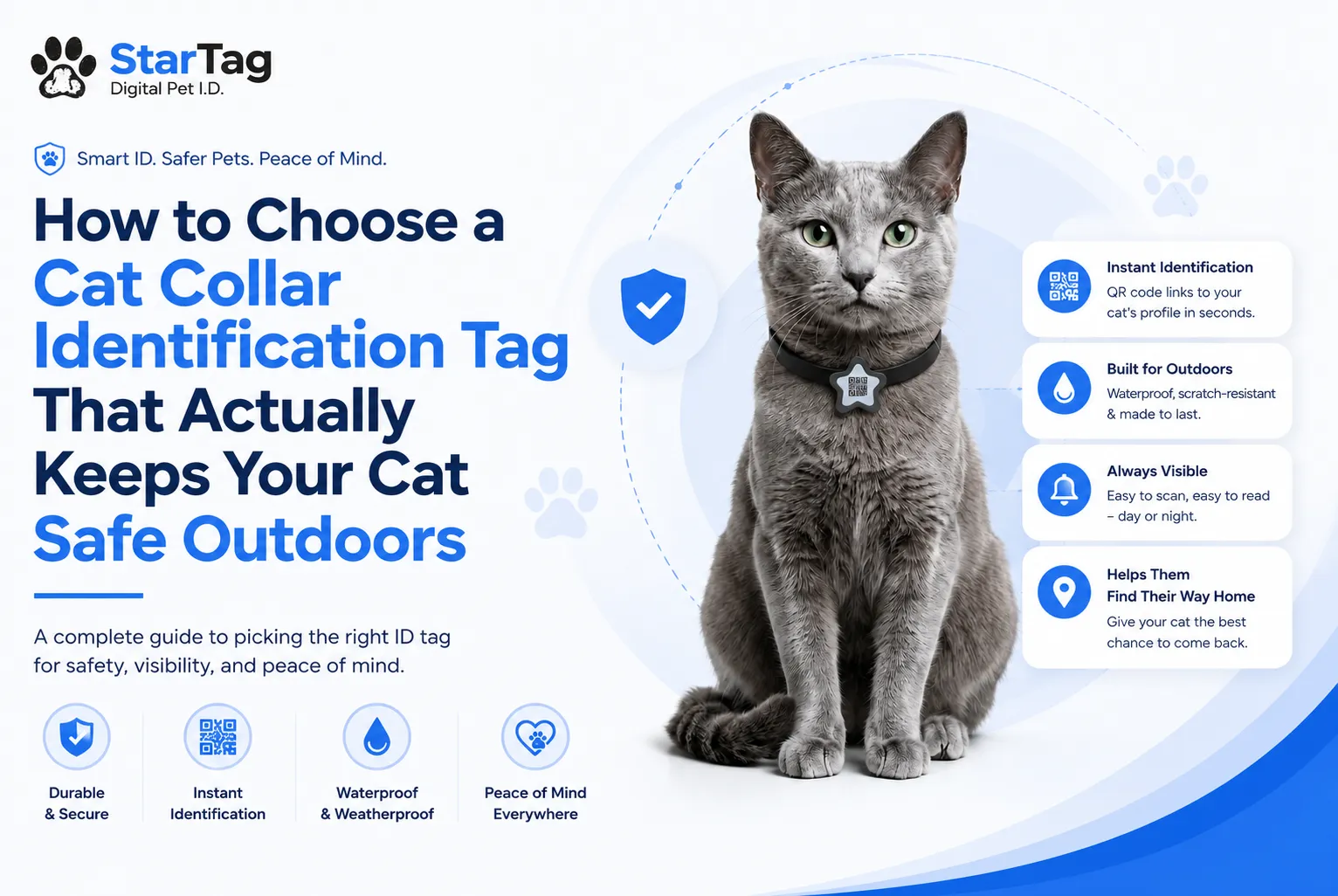
Most cat owners buy an ID tag the way they'd buy a keychain: pick a design, get it engraved, clip it on, done. Then the cat goes missing for two days, comes home with no collar at all, and the owner realizes the tag they picked never had a real chance of doing its job in the first place.
A cat collar identification tag isn't a fashion accessory that happens to carry your phone number. It's a piece of safety equipment, and like any safety equipment, some designs work under real-world conditions and some just look like they should. If your cat spends any time outdoors, unsupervised or otherwise, the difference between those two categories can be the difference between a quick reunion and a much longer search.

The Uncomfortable Truth About Standard Cat Collars
Here's what a lot of pet stores won't tell you upfront: a fixed, non-breakaway collar is one of the more common causes of preventable injury in outdoor cats. Cats are climbers and squeezers by nature. When a collar snags on a fence post, a tree branch, or even a piece of furniture, a cat's instinct is to pull hard and fast, not calmly back out. Without a release mechanism, that pull can lead to choking, jaw entrapment, or a cat stuck somewhere for hours.
This is why the identification tag itself is only half the equation. The collar it's attached to matters just as much, and any high tech pet collar or basic ID collar you're considering should be evaluated on both fronts, not just how good the engraving looks.

What "Safe" Actually Means in a Collar Design
Before comparing brands or styles, run any collar through these three non-negotiables:
A breakaway or quick-release buckle. Under sustained pressure, the buckle should pop open rather than hold firm. Yes, this means you'll occasionally lose a collar to a determined snag. That's a far better outcome than the alternative.
A snug but not restrictive fit. You should be able to slide two fingers comfortably under the collar. Looser, and it risks catching on branches or slipping over the head during a struggle. Tighter, and it becomes uncomfortable or restricts movement.
Lightweight, low-profile hardware. Bulky buckles, heavy tags, or stiff material add unnecessary weight to a small animal's neck and can affect how naturally the collar sits and releases.
If a product skips any of these three, its visual design or added features stop mattering.
Choosing the Right Identification Tag Itself
Here's the part that rarely gets mentioned: a traditional hanging tag, the kind that dangles from a small ring clipped to the collar's D-ring, carries its own snag risk independent of the collar it's attached to. That ring and tag combination sticks out from your cat's neck, and it's exactly the shape that catches on fence wire, dense branches, or the mesh of an outdoor structure. When it catches, your cat doesn't just lose a tag, she can end up with the collar twisted tight enough to choke her, or with her jaw caught between the collar and the snagged tag while she struggles to pull free. In the worst cases, a cat stays stuck like that for hours before anyone finds her.
This is why flat, engraved tags that sit directly against the collar, rather than swinging from a separate ring, are worth prioritizing over decorative hanging designs. If you do go with a hanging tag because of legibility or style preference, pair it with a genuine breakaway collar so the collar itself gives way before your cat's neck or jaw takes the strain.

Cat Trackers vs. Dog Tracking Collars: Why the Specs Actually Differ
It's tempting to assume a scaled-down version of the best dog tracking collars would work fine for cats. In practice, the requirements diverge in a few important ways:
Weight tolerance is far stricter for cats. A tracker built for a 25kg dog's collar is often too heavy and bulky for a 4kg cat, even at reduced size.
Battery life expectations differ. Cats tend to roam in shorter, more localized patterns than dogs on long walks or hikes, so cat trackers usually prioritize compact battery life over the extended multi-day range dog trackers are built for.
Breakaway compatibility is non-negotiable for cats in a way it typically isn't for dog collars, since dogs aren't climbing fences or squeezing through gaps the way cats do.
If you're comparing products originally designed for dogs, check specifically whether the manufacturer has adapted the weight, size, and breakaway mechanism for feline use, rather than assuming a smaller size setting solves the problem.
A Simple Framework for Picking the Right Setup
Match your choice to how your cat actually spends time outdoors:
Occasional supervised outdoor time → A basic engraved ID tag on a breakaway collar covers most of the risk.
Regular unsupervised roaming in a known neighborhood → Add a QR-code tag or reflective elements for faster identification.
Wide-ranging or unpredictable outdoor habits → A GPS-enabled tracking tag becomes genuinely worth the maintenance, paired with a properly fitted breakaway collar.
Common Mistakes Cat Owners Make
Choosing style before function. A beautiful collar with a rigid, non-breakaway buckle is a liability wearing a nice pattern.
Skipping microchipping because a tag feels like enough. Tags and collars can fall off; a microchip is the permanent backup that confirms ownership even if the collar is long gone.
Forgetting to recheck fit as the cat grows or changes weight. A collar that fit perfectly six months ago may now be too loose or too tight, especially in kittens or cats with fluctuating weight.
Ignoring battery upkeep on tech-enabled tags. A GPS tag with a dead battery provides the same protection as no tag at all.

Bringing It All Together
The safest cat collar identification tag setup isn't the most expensive or the most feature-packed, it's the one that pairs a genuine breakaway mechanism with the right level of identification for how your cat actually lives outdoors. Start with the collar's safety mechanism, then layer on the tag technology that matches your cat's roaming habits, not the other way around.
If you're setting up your cat with proper outdoor identification for the first time, startag designs its tags around this exact safety-first approach, built to work with breakaway collars rather than around them, so the setup protects your cat instead of just labeling her.